
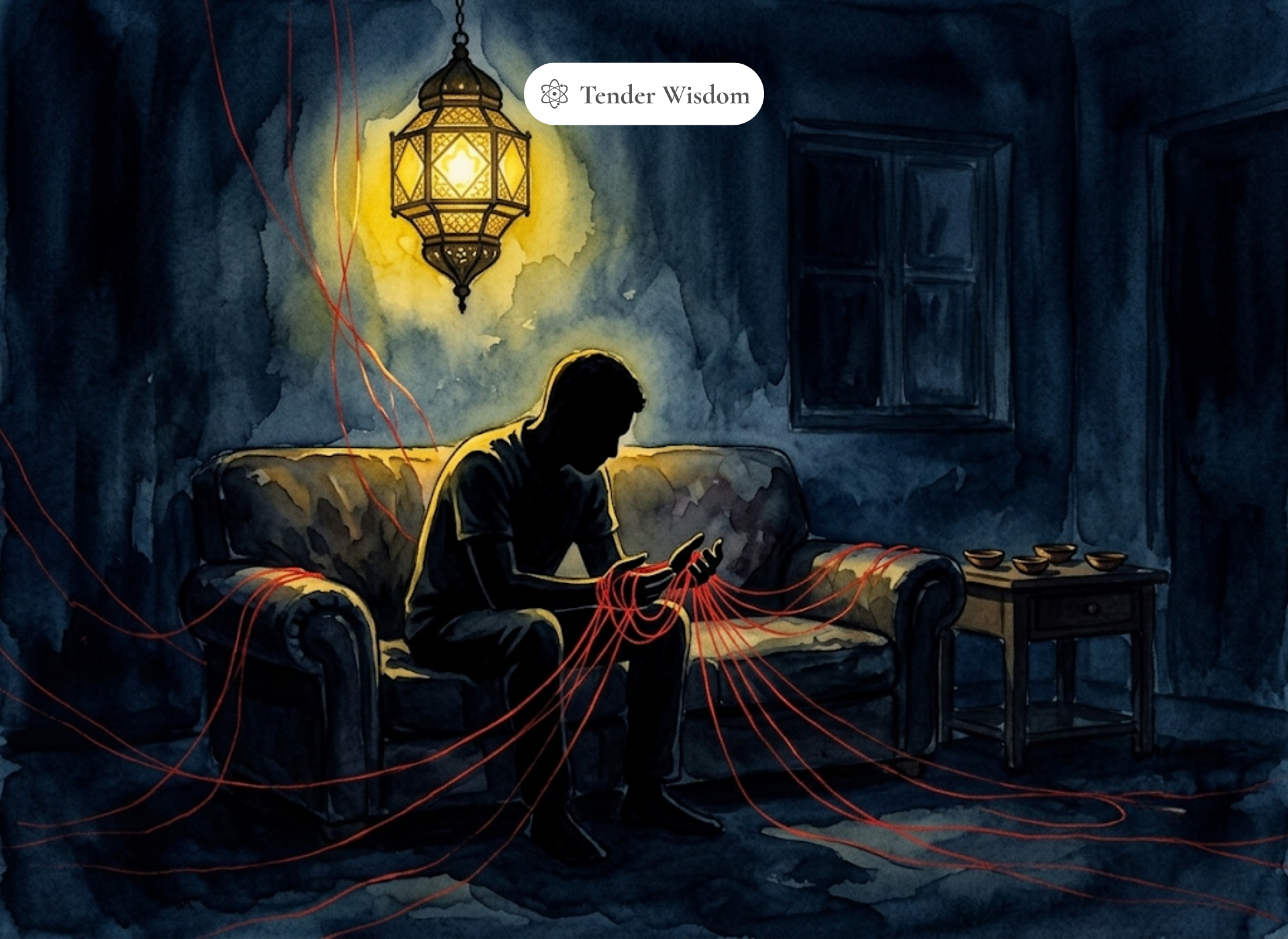
You have that sibling, don’t you? The one who announced at the family dinner table, between the raita and the sabzi, that they were establishing a boundary. Not a boundary in the old sense, the kind that Partition drew with such catastrophic enthusiasm, but a personal one, invisible yet load-bearing, erected specifically to avoid addressing how they may have been at fault with something.
And the aunt! There is always the aunt, who has been unanimously reclassified as toxic by the younger generation, a diagnosis arrived at not through any clinical process but through a podcast consumed during the morning commute on the local Metro train.
Then the lover, of course. Narcissistic. Delivered with the quiet authority of someone who has done their research, which is to say, three reels on Instagram and a quiz that promised to explain everything.
Therapy has had a remarkable rise in India in the last decade. As a millenial, I belong to the generation that spent the initial few decades of their lives believing that therapy was for the sick. It’s for those who have been clinically diagnosed with something major and needed medical interference along with a whole dose of injections and pills. Therapy lived in the background associated with crisis or it was quietly avoided. Today, it sits comfortably in everyday conversation. In less than a decade, we’ve gone from “therapy is for serious problems” to “my therapist thinks…” as a casual aside.
It feels like progress and in many ways, it is. But, here’s my concern… When shifts occur rapidly, they tend to come with distortions. Lately, so many of my consultations happen with clients who have mastered the language of therapy much faster than the experience of it. This worries me deeply. For a while now, we’ve created this wave across cultures and ages, to be pro-mental health without really realising that while the fancy vocabulary has caught on, the real depth of the meaning is entirely missing.
Having worked with an extremely wide and varied range of clients for about two decades now, I have realised that real therapy is absolutely nothing like the terms we throw around in our conversations to our family members or partners or even friends.
In fact, real therapy is not at all articulate while you’re inside it. It is unsettling. Worse, it leads you into rabbit holes of zero clarity. You often leave a session with your therapist with something unfinished or with something that follows you home. It shows up later, in a memory you hadn’t considered important or in a reaction that feels slightly out of proportion. Most days, there is not a single clean takeaway. Just a slow, quiet rearrangement of how you see things. Not particularly shareable.
Meanwhile, for those not in therapy seem to have a robust, thriving ‘therapy’ vocabulary. Trauma, triggers, boundaries, attachment styles. Words that once belonged to clinical spaces now move easily through everyday life, courtsey social media and a range of ‘figure it all out in 5 steps’ kind of self-help books. They all give people a way to describe what they feel, often with impressive precision.
The vocabulary of the therapist’s room has, it seems,
escaped its confines entirely. It travels now by WhatsApp forward,
arriving at all hours, unrequested. One used to need, at minimum,
a couch and a professional and a certain willingness to weep.
Now all one requires is data.
But the thing with language is that it has an unfair advantage over experiences. Unlike experiences, language is easier to acquire and even master. You can understand an emotional pattern and still repeat it. You can name a behaviour and still be run by it. Self-awareness, it turns out, is not self-mastery. This gap shows up most clearly in how we use the language.
“This feels off” becomes “this is triggering.”
“I need space” becomes “I’m setting boundaries.”
All technically valid but also, quite often, convenient. Language is meant to open things up but with these clinical heavy-weights, it closes the conversations. It becomes a way to move past what is really important.
There’s also a new kind of social intelligence emerging – the ability to lightly diagnose everyone around you. You can map someone’s attachment style by the second coffee. Identify their coping mechanisms by the third text. Explain their patterns to them before they’ve fully experienced them.
I have to give it to people these days. Really, it’s impressive! But it is not progress. It is avoidance, dressed in better language. Because the part that actually changes things is slower, less articulate, and significantly less fun. It involves staying in conversations you’d rather exit. Sitting with feelings that don’t resolve quickly. Not immediately converting every experience into a neat explanation. And then, going back to therapy the week after you decided you absolutely shouldn’t. Trust me, that part is definitely not instagram-able. Which may be why it’s easier to stop at the level of language.
Somewhere along the way, we started mistaking awareness for transformation. Learning the language of mental health became the goal rather than the starting point. For many, it stopped there because the next step, the actual work, is harder.
It requires consistency.
Time.
Money.
And most of all, the willingness to sit with your own discomfort without looking away.Real therapy demands that you look at yourself clearly, for an extended period of time. Obviously, most people aren’t prepared for that because if you ask me, its torture.
“I have had clients confide in me about feeling lost in the middle of conversations with their loved one. Family members, lovers and friends can sometimes label behavior patterns before you even understand them yourself. They can shut down conversations by calling them “triggering.” They can frame their own avoidance as self-protection and yours as toxicity. What was originally designed to create understanding starts being used to control, deflect, and avoid. The vocabulary, without the work, becomes a weapon but with a wellness label on it.”
In my opinion, what we’re seeing is not a false shift but just an incomplete one. The words have arrived. The experience is yet to catch up. Because therapy isn’t an identity. It isn’t content. It isn’t an aesthetic. It’s work! And it’s time, to embrace the practice of it to lend a bit of authenticity to our vocabulary.
Written by Medha — an award-winning celebrity astrologer, researcher, teacher, and speaker. If you’d like to explore how the stars shape your unique path, reach out to her for a personal consultation.
