
The Many Ways We Love
Emotional Archetypes, Relationships & the Vedic Lens
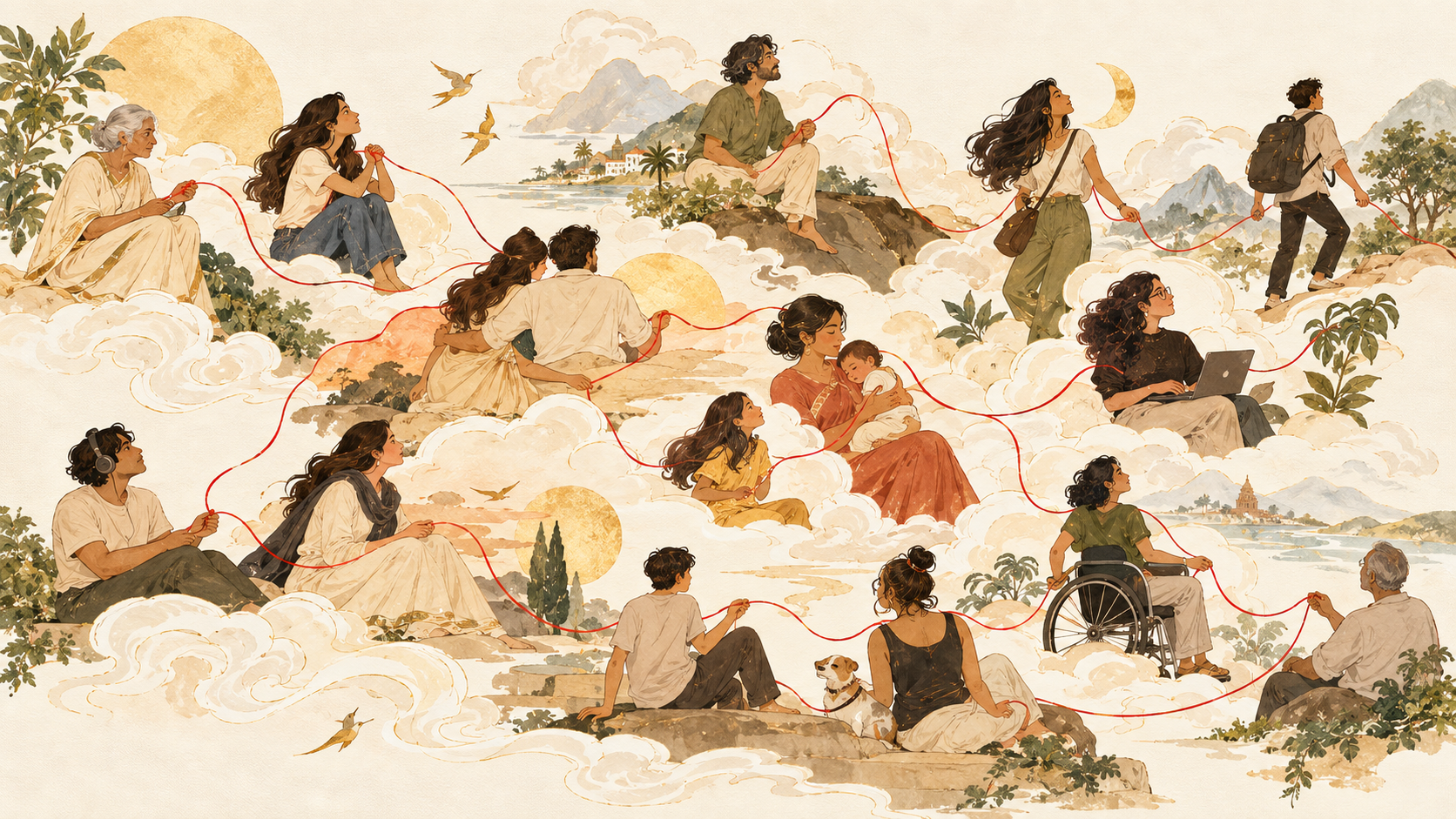
Every human being who has the capacity to love will express that love differently. And, just as importantly, every person will receive love differently. What feels reassuring to one person may feel suffocating to another. What one person experiences as affection, another may experience as pressure. What one person sees as giving space, another may experience as abandonment.
This is one of the most fascinating things about relationships: two people can be standing inside the same relationship and living two entirely different emotional experiences. One person may read a delayed text as an ordinary delay; another may experience it as a floodgate opening inside the mind. One may interpret solitude as healthy space; another may hear it as the first sign of rejection. Neither response automatically makes someone irrational or someone else uncaring. Often, they are simply speaking different emotional languages.
And perhaps the most interesting part is what happens when a relationship ends. We often reduce a complicated human being into a single role: the villain. The person who needed reassurance becomes ‘too much’. The person who needed space becomes ‘cold’. The person who wanted clarity becomes ‘controlling’. The person who left becomes ‘a commitment-phobe’ or ‘someone who never cared’. But people are rarely this simple.
So, as part of understanding relationships a little more deeply, I want to look at some of these emotional archetypes through the lens of Vedic astrology. Not as diagnoses, and not as fixed rules, but as symbolic patterns that can offer another language for understanding why people may behave the way they do in intimacy.
“These placements are suggestive, not definitive.”
The Emotionally Dependent
A delayed text. A slew of thoughts.
For the emotionally dependent archetype, silence from a partner can open the floodgates of overthinking. When reassurance is sought outside the self, the mind begins connecting dots from everywhere. Why are they behaving differently? Did I do something? Are they losing interest? Is something wrong between us? Why aren’t they reassuring me?
The central pattern is not necessarily a desire to control another person. It can begin with a much more vulnerable need: to know that the bond is still safe. The relationship becomes one of the places from which emotional regulation is drawn, so distance can feel disproportionately large.
The Planetary Signature
In a Vedic-astrological reading, this archetype may be symbolically associated with the Moon connected to the 1st or 8th houses, an afflicted Moon, Moon–Rahu or Moon–Venus combinations, or a Moon strongly influenced by watery signs. These are traditionally read as signatures that can heighten emotional sensitivity, attachment, receptivity and the need for emotional security.
The Nakshatras
Mrigashira, Ashlesha, Purva Phalguni, Vishakha and Revati may be considered relevant symbolic expressions of this pattern.
“I need to know what is happening inside you.”
At its healthiest, this emotional intensity can produce warmth, loyalty and an enormous capacity for affection. As a shadow, it can manifest as jealousy, hypervigilance, emotional probing or possessiveness.
The Astrology Behind the Pattern
What looks like a need for constant reassurance may sometimes be an attempt to regulate anxiety. What looks like possessiveness may sometimes begin with something much more vulnerable:
“I am scared that I am losing you.”
The difficulty is that reassurance can temporarily soothe this fear without necessarily resolving what created it. The cycle can therefore repeat: uncertainty appears, reassurance is sought, relief arrives, and then another small uncertainty triggers the need again.
What This Archetype Needs to Learn
Love does not mean having constant access to someone. The lesson is not to become less loving, but to develop a stronger inner sense of safety. This archetype may benefit from learning to sit with uncertainty, communicate needs clearly, and allow the other person space without immediately assuming rejection.
“I can love you deeply without making your behaviour responsible for my emotional peace.”
The Independent
At the other end of the spectrum is the independent archetype. Its core psychological pattern can sound like this:
“I love you, but I am scared to be vulnerable.”
These are often the people who say, ‘I’ll handle it.’ ‘Don’t worry about me.’ ‘I need some time alone.’ They may genuinely value autonomy and feel most secure when they can rely on themselves. Their instinct, especially during emotional difficulty, can be to retreat inward rather than reach outward.
But independence has a shadow. What begins as self-sufficiency can become emotional distance, and eventually emotional numbness. The person may be so practiced at carrying their own weight that they forget intimacy requires allowing another person to carry some of it too.
The Planets
A strong Sun–Rahu combination, Saturn or Ketu in the ascendant, or strong signatures of these planets may, within a Vedic framework, be interpreted as supporting themes of detachment from dependency. In their constructive expression, such patterns can correspond symbolically with confidence, resilience and a strong sense of individuality.
The nakshatras Dhanishtha, Shatabhisha, Mula and Uttara Ashadha can also be explored in this context. In their shadow expression, the pattern may show up as emotional distance, difficulty asking for help, or shutting people out.
What They Need to Learn
Independence is not the same as isolation. You do not lose yourself by allowing someone to love you. Sometimes the bravest thing for an independent person is not saying, ‘I can do this myself,’ but saying:
“I don’t have to. I can still be loved even if I am vulnerable.”
The Controller
The controller is driven by a different fear: uncertainty. The core psychological pattern is:
“If I know what is happening, I can protect myself from what happens next.”
They want to know where the relationship is going. They question. They decide. They seek information because information creates the feeling of safety. Sometimes they may manipulate situations without even realising that they are doing it, while genuinely believing that they are simply being responsible.
The Planets
A dominant Mars, Sun, Moon or Rahu particularly when connected with the 1st or 10th house can be examined for this archetype. Symbolically, Mars seeks action, the Sun seeks authority, the Moon responds to and shapes emotional experience, and Rahu seeks to understand what lies beneath the surface.
Relevant nakshatra themes may include Rohini, Vaishakha, Jyeshtha, Magha and Purva Bhadrapada.
At its healthiest, this combination can produce perception, decisiveness, responsibility and strong leadership. As a shadow, it can manifest as control, emotional manipulation, power struggles, excessive questioning or difficulty trusting others.
What They Need to Learn
Not everything uncertain is dangerous. You cannot control another person’s feelings into becoming stable. You cannot manage someone into loving you. And you cannot protect yourself from every possible disappointment. The deeper lesson is learning the difference between responsibility and the illusion of control.
The Wanderer
Then there is the person who is always looking for the next horizon. The core psychological pattern is:
“Maybe the next person, the next place or the next experience will finally make me feel complete.”
The excitement is intense in the beginning. Then familiarity and monotony arrive. And suddenly the question appears: ‘Is this really it?’ So they move again.
This can happen in relationships too. They do not necessarily leave because the other person is bad. Sometimes they leave because desire was more exciting than possession. Novelty can feel like proof that something meaningful is happening, while familiarity can be mistaken for the absence of love.
The Planets
Rahu seeks more. Mercury seeks stimulation and variety. Together, when these themes are strongly connected to the 1st or 7th house, or when a Mars–Venus–Rahu combination is prominent, Vedic astrology may use them to explore themes of curiosity, desire, freedom and novelty.
Ashwini, Rohini, Mrigashira, Swati, Purva Phalguni and Uttara Ashadha may also be examined in relation to this archetype.
At its healthiest, this produces curiosity, freedom, exploration and openness to new experiences. As a shadow, it can manifest as restlessness, dissatisfaction, difficulty staying, constantly seeking something new, or confusing novelty with fulfilment.
What They Need to Learn
Not everything meaningful has to feel exciting all the time. There is a difference between being stuck and learning how to stay. The Wanderer has to discover the difference between saying, ‘This isn’t right for me,’ and saying, ‘This isn’t exciting anymore.’
“Fulfilment often begins where novelty ends.”
Beyond the Archetypes
These four archetypes are not four boxes into which people can be permanently placed. A person can move between them. Someone may be deeply independent in one relationship and emotionally dependent in another. A controller may become a wanderer when they no longer feel invested. A wanderer may become intensely dependent when they finally meet someone who matters. A person who usually avoids vulnerability may become surprisingly open when they feel safe.
This is also why astrology is more useful as a language of reflection than as a verdict. A birth chart can be read as a collection of tendencies, tensions and symbolic possibilities, but a human being is always larger than a list of placements. Circumstances, attachment history, maturity, culture, choice and lived experience all participate in how someone loves.
And perhaps this is the most important shift: when a relationship ends, understanding becomes more useful than assigning a villain. Instead of asking only, ‘Who was wrong?’, we can sometimes ask, ‘What was each person protecting? What were they afraid of? What did they need but struggle to express? And what did the relationship teach them about themselves?’
Two people can love each other deeply and still have completely different ideas of what love should look like. One may reach for closeness when afraid; another may reach for distance. One may ask questions; another may go quiet. One may need certainty; another may need room to breathe.
That does not automatically make one person the lover and the other the villain. It means that love is layered, and human beings are layered too.
