
What Really Happens After Death And
What Astrology Reveals About the Journey of the Soul
In the vast ocean of Hindu sacred literature, the Puranas stand out as the bridge between divine knowledge and the everyday seeker. These ancient Sanskrit texts, about 4th century AD in origin, translate the philosophical density of the Vedas and Upanishads into stories, symbols, and cultural memory that ordinary people can understand. Compiled by Ved Vyasa, the same sage who narrated the Mahabharata, the 18 major Puranas are dedicated to the Trimurti: Brahma the Creator, Vishnu the Preserver, and Shiva the Destroyer.
Among them, the Garuda Purana holds a unique and misunderstood place.
While texts like the Shiva Purana or Vishnu Purana are read for spiritual growth, the Garuda Purana is traditionally recited only after a person’s death, especially during the 13-day mourning period. This association has wrapped the Purana in fear, superstition, and taboo. Many believe it to be a terrifying account of judgment and hell. Yet this reputation is largely the result of misinformation spread over the years and not the original text.
In reality, the Garuda Purana is a compassionate, structured explanation of the soul’s transition after death. And when seen through the lens of astrology, it becomes even more fascinating because the journey it describes mirrors the subtle movements of the soul across cosmic planes that Vedic astrology speaks of.
Garuda Purana: The Cosmic Dialogue
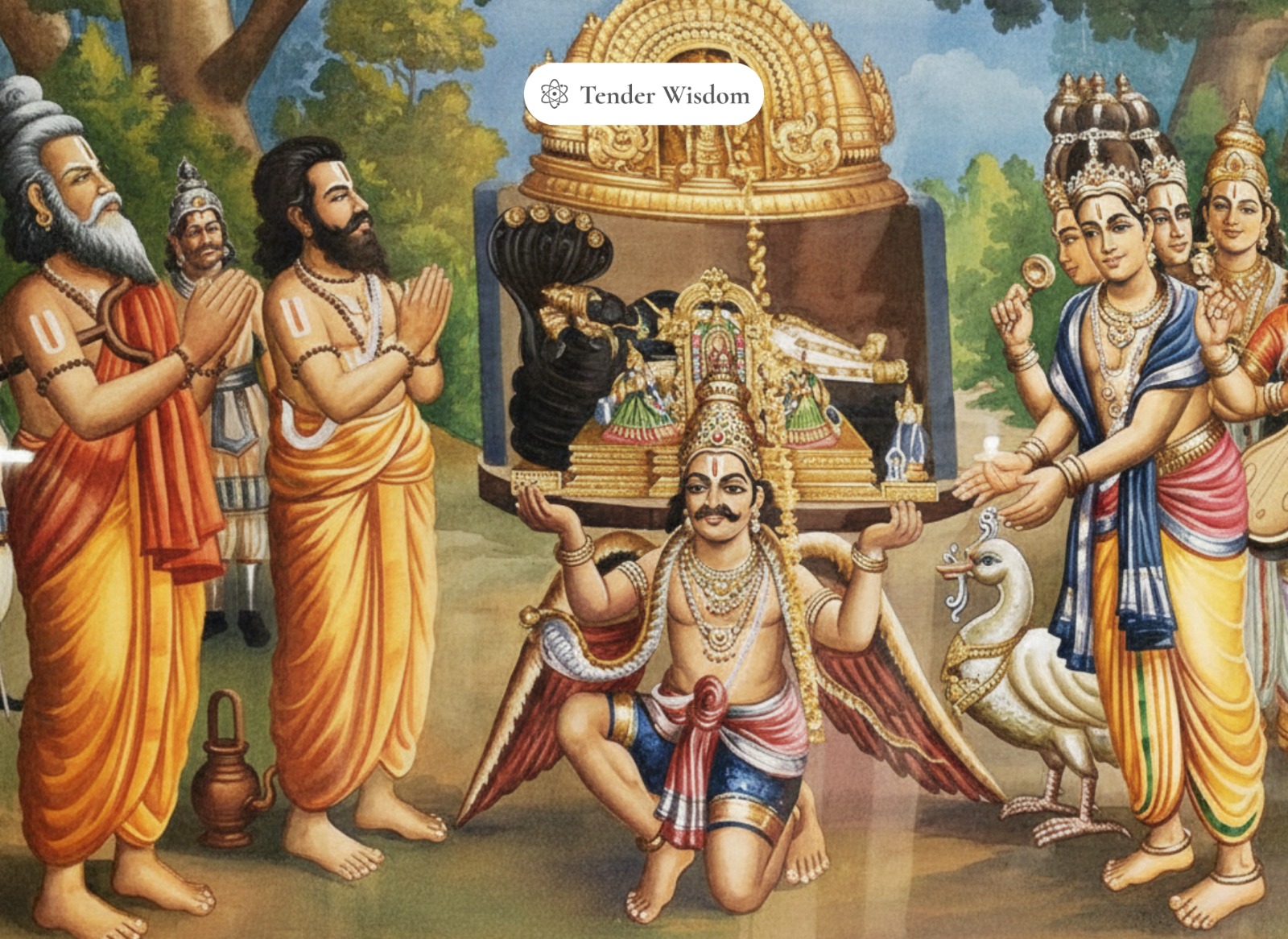
The text unfolds as a conversation between Lord Vishnu and Garuda, the divine eagle and Vishnu’s vehicle. From the heavens, Garuda witnesses the 13-day post-death journey of earthly souls, prompting him to ask Vishnu a series of profound questions:
What is death?
What happens to the consciousness?
What is the purpose of the journey?
How does karma follow us?
The answers form the heart of the Garuda Purana and they align beautifully with astrological principles about the soul (Atma), subtle bodies, karma, and cosmic cycles.
According to Vishnu, death occurs when Prana-Shakti, the life force, withdraws from the physical body. At that moment, the soul realizes its true nature, not body, mind, intellect, or ego, but pure divine energy.
Yet the soul doesn’t immediately ascend. It enters a transitional dimension called Preta-Lok, the in-between space that exists neither on Earth nor in the heavens. The final destination of this journey is Pitru-Lok, the realm of ancestors, where the soul rests, reviews its karma, and prepares for rebirth.
What prevents the soul from rising immediately is ego, the one element not consumed by fire, water, earth, air, or space. Ego binds the soul to memories, emotions, and attachments. Astrology describes this same bondage through karmic imprinting, seen in the Moon, Ketu, Saturn, and the 9th house of lineage.
For the soul to move upward, detachment must happen simultaneously on both sides:
– The soul must release its emotional baggage, and
– The family must release the soul through rituals, helping the passage become clear.
Hence the structured mourning period of 13 days.
Each day corresponds to a symbolic evolution of the soul’s subtle body (Preta-Sharira), a concept echoed in the layers of the astral body described in astrology and yogic philosophy.
The Soul’s 13-Day Journey: From Preta-Lok to Pitru-Lok
Days 1–10: Formation of the Preta Body
Through the offering of 10 symbolic pindas (rice-balls), a new ethereal body is formed: head, senses, limbs, organs, breath, vitality.
The ceremonies also reinforce the soul’s detachment:
- Cremation (Day 1)
- Collecting ashes (Day 2)
- Immersion of remains (Day 3)
- Emotional review (Days 4–7)
- Acceptance of the new body (Days 8–9)
- Final earthly nourishment (Day 10)
On the 10th day, the soul is prepared to leave Preta-Lok, guided by:
Yama, the cosmic governor of karma
Three generations of ancestors
Astrologically, this correlates with the 10th tithi effect, the activation of ancestral karma (Pitru-Dosha), and the soul’s shift through the astral realms governed by Yama, whose influence connects to Saturn, Rahu, and the South direction. This is also the reason a dead body’s head is placed in the North and feet are placed in the south, so the soul can journey smoothly into the realm of Yama.
Day 11: Entry into Pitru-Lok
At this point, the soul is no longer a Preta. It becomes a Pitru, an honored ancestor who now guides the living. The first Pitru Pind-daan is performed.
Day 12: Sapindi-Karan – Merging Into the Ancestral Lineage
This day is the spiritual graduation moment. The departed soul officially joins the lineage of ancestors, replacing the eldest ancestor who now ascends to higher divine realms.
Astrologically, this process is mirrored in:
- The 9th house (ancestors, Dharma)
- Ketu (past lives)
- Saturn (karmic ledger)
It symbolically resets ancestral energy patterns in the family.
In Astrology too, we have 12 houses in a birth chart, symbolising 12 stages of one’s life. An as astrologer, I judge the birth of an individual through their 1st house and their exit from this realm from the 12th house. Hence, it is only after completing the various stages of life, a person’s birth is believed to be complete and culminated.
The number 12 signifies finality and completion and you will notice this pattern in a variety of things around you – hours in a clock, months of a year, division in a horoscope, number of zodiac signs in astrology, the age of maturity of Jupiter, number of pairs of ribs in the human body, number of inches in a foot, and the list goes on. The Moon makes 12 revolutions around the Earth for one revolution of Earth around the Sun. In fact, even the total number of elements in nature is believed to be 12 –
- Earth, Water, Wind/Air, and Fire (the four classical elements)
- Additional elements such as Thunder, Ice, Force, Time, Flower, Shadow, Light, and Moon.
Day 13: Closure and Return to Normalcy
This day is important as most relatives, near and far, visit the departed person’s family on this day, even if they couldn’t be present for the other days. The 13th day marks the day of fresh beginnings and ‘moving-on’ from what has passed on from this realm. We believe that we grieve for 12 days and from the 13th day, we bid farewell to our loved one and resume our responsibilities and life’s journey. This is the day when fire worship resumes: after the rituals of this day, one can light a diya/lamp in their home temples as they would have before. This day symbolizes purity and the end of the impure mourning period. Life returns to its rhythm, what Vishnu calls Vishnu-Maya, the cosmic illusion that makes us carry on with worldly life.
Astrology and the Garuda Purana: Two Maps of the Same Sky
Astrology describes life as a series of karmic imprints carried across births.
The Garuda Purana describes the same cycle through the language of ritual, symbolism, and spiritual metaphysics.
Both agree on essential truths:
- The soul is eternal.
- Karma shapes birth and rebirth.
- Emotional attachments bind us to the cycle.
- Liberation (Moksha) is the ultimate goal.
- Ancestral energy influences the living.
- Every soul must journey through multiple dimensions after death.
Where astrology charts these transitions through planets, houses, and karmic nodes (Rahu-Ketu), the Garuda Purana narrates the soul’s internal experience of the same celestial process. Like astrology, it reminds us that life is eternal, and that death is merely a doorway to the next chapter of our soul’s journey.
A message for the year 2026
As we approach the close of another year, the wisdom of the Garuda Purana becomes particularly relevant. Though the text speaks about the final transition of the soul, its lessons are not only about physical death, they are about the endings we face throughout life, and the way each ending creates the space for a new chapter.
According to the Purana, nothing truly ends; it simply transforms. Every experience we ‘let go’ of whether a relationship, a belief, a job, an identity, or a painful memory goes through the same spiritual process as the soul does after death: review, release, merging, and renewal.
The closing of a year mirrors this beautifully.
This is the time when we naturally reflect on:
what served us,
what burdened us,
what shaped us, and
what we must now release.
Just as the soul sheds its attachments to move upward, we too must shed emotional, mental, and karmic residue to move forward into the year ahead. The Garuda Purana teaches that growth begins only when we consciously let go and we must do so with awareness and gratitude.
The Garuda Purana reminds us that life is a continuous flow of endings and beginnings. As this year closes, allow yourself to release the weight of what has passed, honor the lessons it brought, and step with a lighter heart into the future.
Every ending is a doorway.
Every beginning is a blessing.
And every moment is a chance to align deeper with your soul’s journey.
Written by Medha — an award-winning celebrity astrologer, researcher, teacher, and speaker. If you’d like to explore how the stars shape your unique path, reach out to her for a personal consultation.
